Thursday, November 18, 2010

End Behaviors

The degree of an equation tells you how many times on the graph the line is going to turn. The number of turns the line has will be one less than the degree of the equation.
A monomial is a 0 degree constant.
A 1st degree equation is a linear equation and it is known as a binomial.
A 2nd degree equation is a quadratic equation and is known as a trinomial.
A 3rd degree equation is a cubic equation and is a quadrinomial.
A 4th degree equation is a quartic equation and is a polynomial.
A 5th degree equation is a quintic equation.
Domain-X values
Range- Y values 
  • domain → +∞, range → +∞ (rises on the right)
  • domain → -∞, range → -∞ (falls on the left)

  • domain → -∞, range → +∞ (rises on the left)
  • domain → +∞, range → -∞ (falls on the right)

  • domain → +∞, range → +∞ (rises on the right)
  • domain → -∞, range → -∞ (falls on the left)

  • domain → +∞, range → -∞ (falls on the right)
  • domain → -∞, range → -∞ (falls on the left)

Tuesday, November 9, 2010

Identifying Quadratic Functions

The standard form of a quadratic function is ax² + bx + cy² + dy + e= 0
A quadratic function is a circle when a=c.
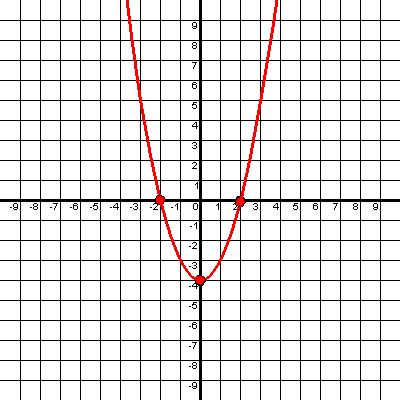
A quadratic function is a parabola when either a or c equals 0.
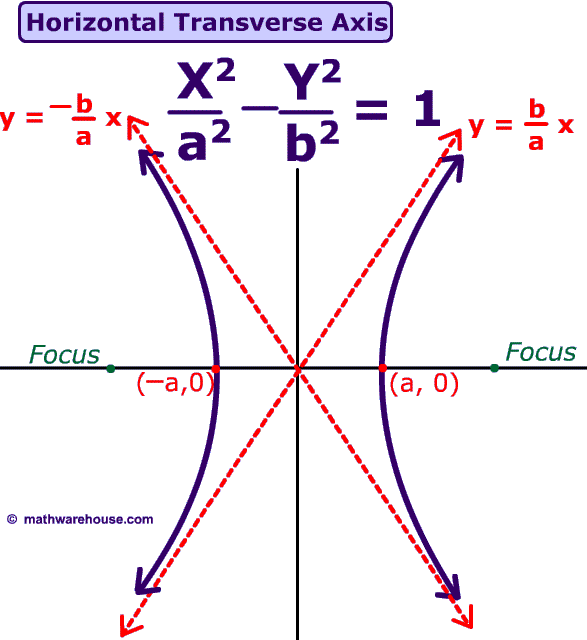
A quadratic function is a hyperbola when a and c have different signs.
A quadratic function is an ellipse when a and c have the same sign, but a is not equal to c.
Example of a circle:

Example of a parabola:

Example of a hyperbola:

Example of an ellipse:

Wednesday, October 6, 2010

Matrix Multiplication

To find out if you can multiply two matrices you have to find the dimension statement. The dimension statement states that in order to multiply matrices the first matrix's columns must have the same amount of columns as the second matrix's rows.
Dimension Statement Example: 2X2 times 2X3
The highlighted numbers above show that these two matrices can be multiplied.

The size of the new matrix will be the size of the first matrix's rows by the second matrix's columns.
Example: 2X2 times 2X3
The new matrix's size is 2 rows X 3 columns
To multiply matrices you multiply the first matrix's rows by the second matrix's columns.
Example:

Tuesday, September 21, 2010

Dimensions of A Matrix

You find the dimensions of a matrix by counting the rows and by counting the columns. The rows of a matrix goes from the left to the right, but the columns of a matrix goes up and down. The dimensions of a matrix is displayed as row by column.
1x3 Matrix

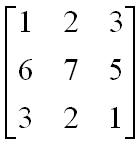
3x3 Matrix


3 x 2 matrix.


  3 x 3 matrix.


Thursday, September 16, 2010

Error Analysis


1) 
It is wrong because they did not notice that the gragh was going up by 5 instead of 1.
Answer: y=2x+9

2) 
It is wrong because they should have tried to check it on both of the equations.
Answer: (1.1,-1.5)
3) 
22 is wrong because it should have a dotted line. Number 23 is wrong because it should be shaded above the line.
4)
20 is wrong because it should have a dotted line. Number 21 is wrong because it should be shaded below the line.

Tuesday, September 14, 2010

Graphing Absolute Values

The equation for absolute value equtions is y=a|x-h|+k.
The vertex of the graph of an absolute value equation will be (h,k).
The a in the equation tells you if the equation will open up or down.
If h is negative the vertex will move right by the number that h is, but if h is positive it will move left by the number that h is.

Systems of Equations

Independent and consistent system
Inconsistent system
Dependent system
graph of intersecting lines
graph of parallel lines
graph with one apparent line

:
Independent systems have one solution and
one intersection point.


Inconsistent systems have no solution and
no intersection point.


For dependent systems the solution is the
whole line.